Agent Configuration

Installing your Agents

Agent installation and configuration

In this section, we will deep dive into deploying the Pia Agent into your environment.

The Pia Agent is required to be installed on any device which is to be supported in terms of running packages on the device. At present, Pia is supported on the following Operating Systems and Classes:

  • Windows Server 2016 or higher
  • Windows 10 or higher
For ConnectWise Automate, we have constructed a package which can be imported into your instance to facilitate with the deployment.

This packages includes the following:

  • An EDF to define Pia values per Client
  • Install, uninstall and reinstall scripts
  • Searches for determining whether Pia is installed
  • Groups to categorise endpoints based on the search above

You can download this package from here: https://piavideos.blob.core.windows.net/videos/CW%20Automate%20Pia%20Deployment%20Setup%20+%20Scripts.zip

info

Note 1: As the .xml contents of the package are not readable to determine the actions prior to import, we have provided screenshots in the .zip file to show the expected result after import.

Note 2: Please import the .xml file called "Group - Pia.xml" first BEFORE importing any of the other .xml files provided in the .zip file. Not doing so risks causing database corruption.

  1. Import the .xml files by going to System > General > Import > XML Expansion

23-cwa-xml1.png

  1. After importing each .xml file, please check the Groups, Searches, Scripts and EDF sections to confirm that the items are visible as per the provided screenshots.

  2. The imported scripts to install and reinstall Pia require editing to point to your Pia Tenant FQDN. Navigate to Automation > Scripts > View Scripts

24-cwa-script1.png

  1. Select the "Pia" folder under the scripts pane. You will see the scripts for Pia listed in the main pane.

25-cwa-script3.png

  1. Right-click on the "Pia - Install Agent" script and choose "Open".

  2. In the script, navigate to the "Then" section and double-click on step number 8. You will see the install string has the -tenantname argument entered as "tenantname.pia.ai" - change this to your tenant name FQDN(same as the Pia Portal).

  3. Save the changes to the script.

  4. Repeat steps 4 to 6 for the scripts called "Pia - Reinstall Agent" and "Pia - Reinstall Agent - Clear Certificate"(step numbers to update the tenantname are different in these scripts).

25-cwa-script2.png

note

In the above screenshot, the link displayed in Statement 7 is to an Azure Blob Storage located in Australia. If you have geo-filtering enabled and are in the United States, we have the following US Azure Storage Blob which is hosted locally that you can utilise:

https://piatenantadminprodus.blob.core.windows.net/piareleases/Pia.OrchestratorAgentService.exe

Replace the link in Statement 7 of the screenshot with the above link if you are in United States.

  1. At this point, it is time to commence filling out the EDF for Clients. In the Clients list, right-click on a Client and choose "Open". Then in the Client Properties window which appears, navigate to Info > Pia tab.

  2. In the Pia tab you will be presented with 2 options, a tickbox to deploy the Pia Agent and a Client ID. Tick the box to Deploy Pia Agent and enter in the Pia Client ID Number. For a list of your Pia Client Id's , please refer to the Id column on the Clients page in your Pia tenant portal.

2022-12-14_09_21_15-cwautomate-edf.png

  1. After entering in the information, click "Save Additional Information".

  2. After some time, the endpoints for the Client will appear in the "Pia - Not installed" group after the search has ran.

  3. When you are ready to deploy the Pia Agent to your endpoints, the final step is to configure a scheduled script on the "Pia - Not installed" group.

  4. Navigate to Browse > Groups(tab) > Pia(folder) > Pia - Not Installed

26-cwa-group.png

  1. Right-click on "Pia - Not Installed" and choose "Open".

  2. In the "AutoJoin Searches" section under the "Computers" dropdown, choose the group "Pia\Pia - Not Installed" from the list and tick "Limit to Search". Then, click on the "Computers" tab.

26-cwa-group1.png

  1. Click on the "Scheduled Scripts" tab.

  2. Set the script to "Pia\Pia - install Agent" and then set the "Limit to Search" dropdown to "Pia\Pia - Not Installed". We recommend a weekly schedule starting at 9am and running over normal business hours.

26-cwa-group2.png

  1. Click "Save" once completed.

  2. Monitor your endpoints to confirm the Pia agent is being deployed and machines are moving from the "Pia - Not Installed" group into the "Pia - Installed" group.

Agent Activation​

In the Pia Portal, the Installed Agents must be manually activated before it can start communicating with Pia. Follow the steps below to learn how you can activate Pia Agents in the Pia Portal:

  1. Go to Configuration in the left hand menu and navigate to the Agents option.

  2. Click on the sort button in the Activated column so that you can see ALL the Agents that are installed but de-activated. You can also search for the Agent using the Search bar.

  3. Select the Agents you wish to activate. You can also use the top-left checkbox to select All.

  4. Click on 'Activate' button. This will activate the Agents.

Alternatively, you can follow the steps below to activate a single agent:

  1. Click on the Device Name. This will open up additional options for the device

  2. The Activated drop-down will have two options. Select "Activated" option

  3. Click on "Save Details" button

Uninstalling and Reinstalling​

Uninstall and reinstall scripts have been provided. With these, there are two options, a standard uninstall and reinstall script respectively and another which also clears the certificate. Unless advised by Pia Support, we recommend using the script which doesn't clear the certificate. These can simply be run on an endpoint inside Automate, same as any standard script.

Configuring Automated Time Logging in Pia aiDesk

In Pia aiDesk Platform 16, we introduced a new feature for Automated Time Logging, allowing MSPs to log time entries automatically in their PSA once an automation package is completed. This ensures that engineers' time is accurately tracked, providing transparent billing for clients.

Why Use Automated Time Logging?​

Automated Time Logging allows MSPs to:

  • Track time effortlessly: Automatically log the time spent on automation tasks without manual entries.
  • Increase billing accuracy: Ensure all tasks are properly billed to clients based on time spent by engineers.
  • Improve operational efficiency: Minimize the risk of time entry errors and focus on delivering services.
info

Supported PSAs: ConnectWise, Autotask, and HaloPSA.

How to Configure Automated Time Logging​

Step 1: Access the Pia Portal​

  1. In the Pia aiDesk portal, navigate to Configuration from the main menu on the left sidebar.

  2. Under Configuration, click on Tenant Settings.

Step 2: Enable Automated Time Logging​

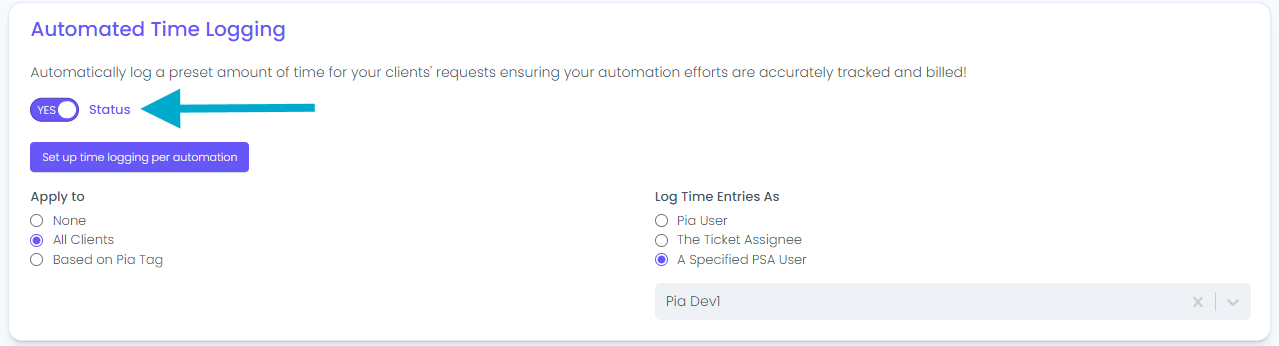
  1. Scroll down to the Automated Time Logging section.

  2. Toggle the Status switch to β€œYes” to enable the feature.

alt text

info

By enabling this feature, Pia will automatically log time for completed automation tasks.

Step 3: Configure Logging Settings​

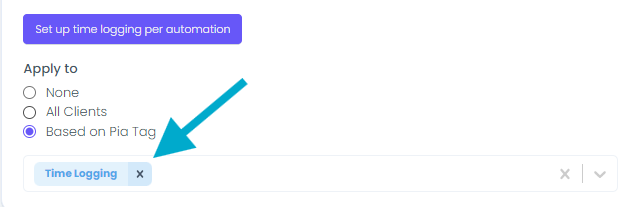
  1. In the Apply to section, you can choose how you want time logging to be applied:

    • None: Disable time logging for all clients.
    • All Clients: Enable time logging for every client.
    • Based on Pia Tag: Enable time logging for clients based on specific tags.
    alt text

info

Choosing Based on Pia Tag gives you the flexibility to assign time logging rules to specific client categories. For example, you can create a brand new tag in the Pia portal, such as "Time Logging," to track automation tasks for general purposes, or create a tag based on the client's contract, like "Ad-hoc," to monitor tasks tied to non-standard agreements.

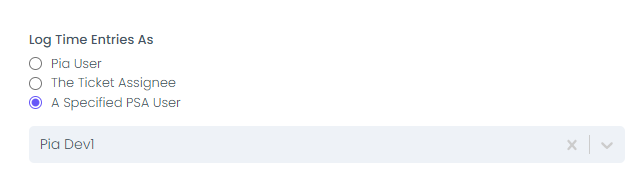
  1. Select who the time entries should be logged as under Log Time Entries As:

    • Pia User: Logs time as the user who starts the automation package.
    • The Ticket Assignee: Logs time under the ticket's assigned engineer.
    • A Specified PSA User: Logs time entries against a specific user in your ticketing system.
    alt text

tip

This option is particularly useful if your clients are using SmartForms, or if you want to log automated entries under a generic static user like piatimelogging@yourmsp.com. This ensures consistent and predictable tracking of automated time entries across your PSA.

Step 4: Set Time Logging Per Automation​

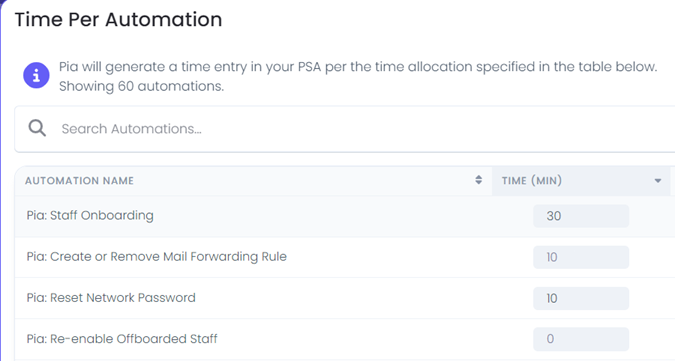
  1. Click on Set up time logging per automation to configure specific time logging for each individual automation package.

    You can adjust the time logged for each Pia automation, ensuring that the correct amount of time is reflected in your PSA for different types of tasks.
alt text

Step 5: Save Changes​

  1. After configuring the settings, ensure you click on the Save button to apply your configurations.

Step 6: Verify Time Entries in Your Ticketing System​

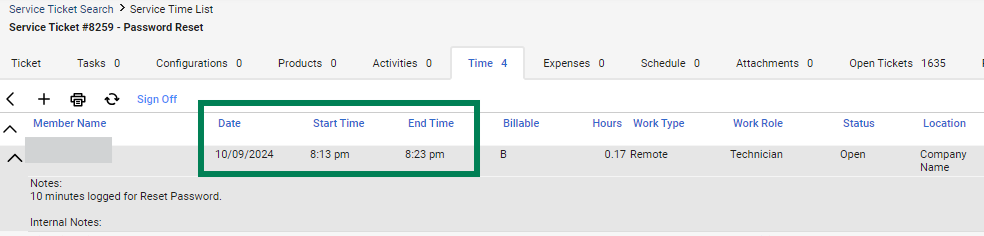
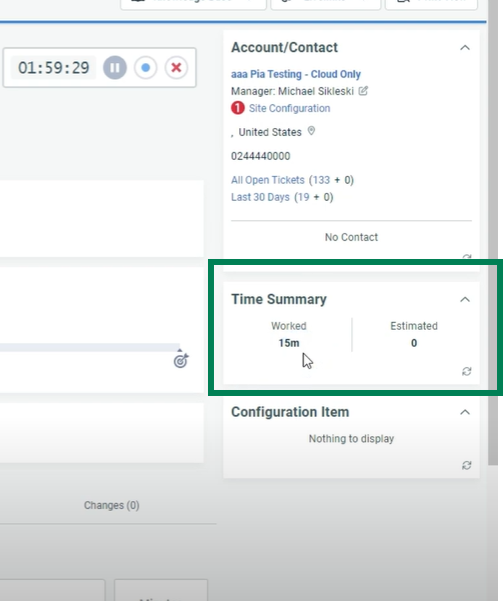
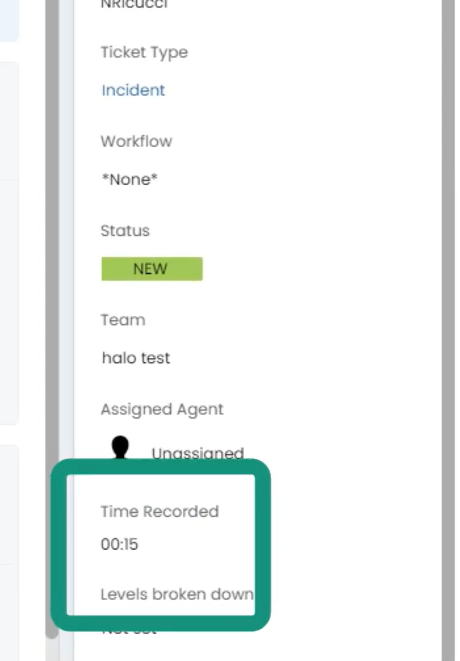
  1. Once the automation task is completed, Pia will create a time entry in your ticketing system. The entry will include:

    • Start time: The time the automation began.
    • End time: The time the automation finished.
    • Ticket notes: Any relevant details about the automation task, automatically logged within the ticket.

    You can verify the time entry under the ticket in your PSA to ensure it accurately reflects the time spent on the task.

You can verify the time entry under the ticket in your PSA to ensure it accurately reflects the time spent on the task.

Time Entry Verification for Different PSAs​

alt text

info

In ConnectWise, the Billable field will be automatically stamped based on the customer's agreement, ensuring correct billing.

info

In ConnectWise, time entries must be recorded up to the current time, meaning future time entries are not allowed. As a result, when Pia generates a time entry, it adjusts the start and end times to fit within the current time frame. For example, if a 20-minute time entry is generated at 12:30 PM, the end time cannot be set to 12:50 PM. Instead, the entry will reflect time "in the past" and will show as Start Time 12:10PM - End Time 12:30PM to ensure compliance with ConnectWise’s time tracking rules.